


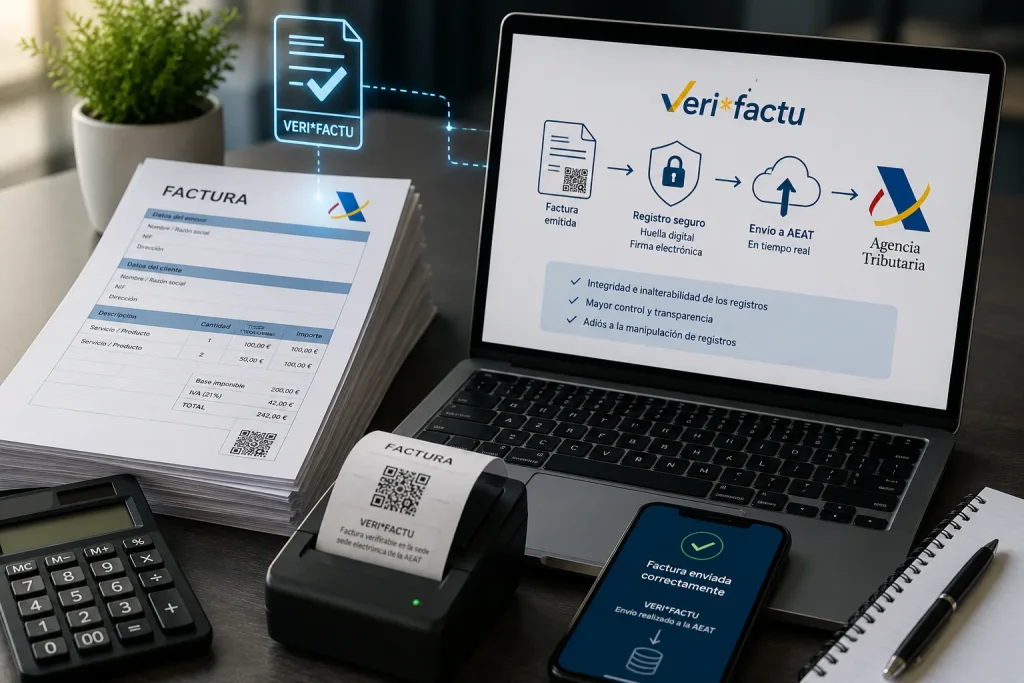
The invoicing obligations in Spain is one of the most important formal duties for any business or professional operating in Spain. With the forthcoming introduction of the VeriFactu system — whose entry into force has been postponed to 2027 — the technical and control requirements will be significantly strengthened. Understanding precisely which invoices must be issued, when, and with what content is more important than ever, not least to ensure businesses are ready when that moment arrives.
Obligation to issue invoices.
Every business owner and professional is required to issue an invoice, and to retain a copy, for all supplies of goods and services carried out in the course of their economic activity. This obligation also extends to advance payments, with the sole exception of exempt intra-Community supplies of goods.
The obligation arises with particular force when the recipient is another business or professional, when the recipient requires it for the exercise of a tax right, when the transaction involves an export or an exempt intra-Community supply, or when the recipient is a public authority or a legal entity not acting as a business or professional.
There are, however, certain exceptions to this obligation. These include VAT-exempt transactions in specific sectors, transactions carried out under the Special Scheme for the Equivalence Surcharge or the Simplified Scheme, agricultural, livestock and fishing activities under the relevant special scheme, and financial and insurance transactions. In all these cases, however, the exception is not absolute: where the recipient is a business or professional and so requests, or where the transaction involves the supply of real estate, an invoice must be issued without exception.
Types of invoices:
Spanish law distinguishes two main types of invoicing document: the full invoice and the simplified invoice.
- The full invoice is compulsory for business-to-business transactions. It must include the identification details of both the issuer and the recipient , name or company name, tax identification number and registered address , a sequential invoice number and series, the date of issue and the date of the transaction, a description of the goods or services supplied, the taxable base, the applicable VAT rate, the VAT amount and the total amount payable. Where a single invoice covers both exempt and non-exempt transactions, or transactions subject to different VAT rates, the respective taxable bases must be broken down separately.ç
- The simplified invoice broadly equivalent to a receipt, is intended for lower-value transactions or sales to end consumers. Its requirements are less demanding, although if the recipient is a business or professional and expressly requests it, the invoice must be supplemented with their tax identification number, address and a breakdown of the VAT amount.
In addition to these two standard types, Spanish law provides for recapitulative invoices, which group together multiple transactions for the same recipient within a single calendar month and must be issued no later than the last day of that month, and corrective invoices, which must be issued when the original invoice fails to meet a legal requirement, when the VAT amount was incorrectly calculated, or when returns, discounts or other adjustments to the taxable base occur. Corrective invoices must clearly identify the original invoice they are correcting, carry their own series, and be issued within a maximum period of four years from the date on which the relevant circumstance came to light.
Invoice codes:
Under the future electronic invoicing framework, each invoice will need to be classified with a code identifying the type of transaction. The most relevant are as follows:
- Code F1 covers full invoices and simplified invoices that identify the recipient;
- Code F2 covers simplified invoices without recipient identification and full invoices not falling under F1;
- Code F3 is used when a simplified invoice is replaced by a full one.
For corrective invoices,
- Codes R1 to R5 cover the various scenarios: returns, discounts and price adjustments (R1), insolvency proceedings against the customer (R2), bad debts (R3), all other corrective cases (R4), and correction of simplified invoices (R5).
Becoming familiar with these codes now makes sense, as invoicing software will use them to generate and transmit control records to the Spanish Tax Agency once VeriFactu comes into force.
VeriFactu explained.
Although the obligation to adapt invoicing software to the new technical regulations has been postponed until 2027, it is worth understanding now what VeriFactu will involve in practice. Its aim is to guarantee the integrity and unalterability of invoicing records and to enable real-time tax control, closing off the avenues for manipulation that have existed until now.
Under this system, each invoice issued will need to include a QR code enabling its verification. Where the software transmits records automatically to the Tax Agency, the invoice will also need to include the specific wording “Factura verificable en la sede electrónica de la AEAT” or simply “VERI*FACTU”. In addition, the invoicing system will be required to generate and retain registration and cancellation records for each invoice, each carrying a digital fingerprint and an electronic signature to certify that they have not been altered.
In practice, all of these elements will be generated automatically by approved invoicing software. What matters is to act in advance: to verify that the software currently in use will be capable of meeting the new requirements, or to plan in good time for a transition to a compliant solution. The postponement to 2027 is an opportunity to make that transition without pressure — not a reason to defer the matter.
Using Word or Excel.
Businesses that issue invoices using basic word processing or spreadsheet software, without data processing or macros, will fall outside the scope of VeriFactu. However, this does not place them in a comfortable position: precisely because they will not be integrated into the automated control system, they are likely to be subject to more frequent periodic inspections. It is therefore particularly advisable for these businesses to maintain rigorous and well-organised records of all their invoices, both issued and received, from this point onwards.
Compliance and risks.
Failure to comply with invoicing obligations can result in significant penalties. If you have any questions about whether your current system will meet the new requirements, or about which type of invoice applies to a particular transaction, our team can help you review your position and plan ahead.
ÁLVARO MORALES SOUSA
PARTNER – LAWYER
CUSTOM REPRESENTATIVE

TempleCAMBRIA informs that the information provided through our blogs, website, or social media channels is for informational purposes only and is therefore insufficient for making decisions or adopting positions in specific cases.
Users should be aware that legislation and case law may change over time, and the content published through these channels may not be fully up to date. Accordingly, we recommend seeking tailored legal advice.
TempleCAMBRIA is a law firm focused on providing legal services to international clients. Our mission is to support you in ensuring that your decision to live or conduct business in our region is a success, and to make your time with us a truly rewarding and memorable experience.