


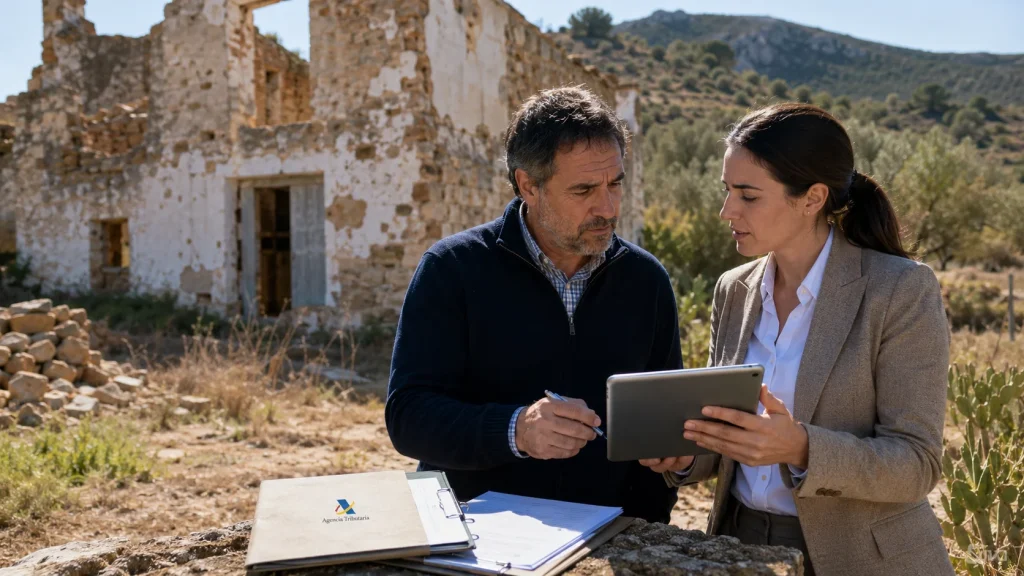
Imputed real estate income is a tax obligation that often surprises property owners in Spain. Even if a property does not generate actual income, it may still have to be included in the Spanish income tax return if the rules consider that the owner can use or enjoy it.
This raises many questions in specific cases: unbuilt urban plots, rural properties, agricultural buildings, empty homes or ruined buildings. Not all properties are taxed in the same way, so it is important to know when there is an obligation to declare and when there is not.
What is imputed real estate income?
Many property owners are surprised to discover that the Spanish Tax Agency requires them to declare income for a property that does not generate any actual income: it is not rented out and, even so, it must be included in their tax return. This is known as imputed real estate income: simply because you are able to use or enjoy a property that is not your main residence, the Personal Income Tax rules impute a theoretical amount, calculated as a small percentage of the cadastral value. However, not all properties fall under this regime. It is important to know what is taxable and what is not.
Properties that do NOT generate imputed income.
- Unbuilt urban land. An empty urban plot, with no construction on it, does not generate imputed income. The law expressly excludes unbuilt land.
- Bare rural land. Farmland, pastureland, woodland or vineyards, without any buildings, do not generate imputed income either. For the same reason as an empty urban plot: there is no construction on which the tax can be applied.
- Essential agricultural buildings. Machinery sheds, storage buildings or facilities that are genuinely necessary for agricultural, livestock or forestry activity are excluded.
- The main residence and properties that are rented out, which are already taxed in another way, or properties used for an economic activity.
Properties that DO generate imputed real estate income.
Second homes, inherited flats that remain empty and unrented premises are subject to imputed income. In rural areas, the dwelling, farmhouse or recreational house located on rural land is also subject to imputed income: a residential building is not essential for the agricultural activity, and therefore it does generate imputed income.
There is an important nuance in rural properties: the imputed income applies to the construction and to the portion of land assigned to it by the Cadastre (the footprint of the building and its surrounding area) not to the hectares of countryside around it. Agricultural land remains excluded; what is included is the house and the land that accompanies it for cadastral purposes.
Ruined buildings: when they must be declared.
It is very common to think: “if the house has collapsed and cannot be lived in, I do not have to declare anything”. That conclusion is precisely the one rejected by the Spanish Tax Agency. The law does not exempt a property simply because it is deteriorated: what it requires is that the property is not capable of use, and the state of ruin, by itself, does not automatically amount to that impossibility.
It is not enough for the construction to be old or in need of renovation. The burden of proving that it cannot be used falls on the owner. To support this, objective evidence is required: an official declaration of ruin from the Town Hall, a technical report or an urban planning file. Without that support, the prudent approach is to declare it.
Conclusion: analyse the property before filing.
In short, it is not enough for a property to be empty, unrented or not generating actual income. What matters is whether, under the Spanish income tax rules and the cadastral information, there is a construction capable of use that may generate imputed real estate income.
In cases involving plots, rural properties or ruined buildings, the details are decisive: the use of the property, the existence of a construction, its cadastral status and its real capacity for use can completely change the tax treatment.
You may also be interested in:
Income Tax Return in Spain: what every expatriate needs to know
Principal residence reinvestment exemption in Spain: how it works
ÁLVARO MORALES SOUSA
PARTNER – LAWYER
CUSTOMS REPRESENTATIVE

TempleCAMBRIA informs that the information provided through our blogs, website or social media channels is for informational purposes only and is therefore insufficient for making decisions or adopting positions in specific cases.
Users should bear in mind that legislation and case law are subject to change over time, and therefore the content published through these channels may not be fully up to date. Accordingly, we recommend seeking personalised legal advice.
TempleCAMBRIA is a law firm focused on providing legal services to international clients. Our mission is to support you so that your decision to live or develop business in our area is a success, turning your stay into a fully satisfactory and memorable experience.